|
HISTORICAL
BIOGRAPHIES
Alberd, Reginald. The reeve of Westminster Abbey's manor of Bourton and Moreton in the
late 1290s, and one of Bourton's leading inhabitants. By 1327 he was dead and
his son Richard Alberd had his holding.
Alfrith. The first named inhabitant of Moreton. He was the Anglo-Saxon freeman
who was the Abbot of Westminster's tenant of half a hide at Moreton in 1066
and 1086 - the only Saxon in the area who kept his holding under the Normans. He was a
radman, one of an Anglo-Saxon group who did riding service, perhaps as
messengers or escorts, perhaps as members of a force guarding the Welsh
frontier. Although he was free, he owed service to the Abbot of ploughing,
harrowing, mowing and reaping.
Allen, Jim was an undertaker, painter and decorator in Moreton for many years.
Born in the town, he joined his father William in the family business in the
1930s after some years boat-building in Cornwall,
and later ran it until his death in June 1981 at the age of 68. He was a
notable sportsman, playing football, cricket and hockey for the town. He was
a member of the local Oddfellows, and served in the Home Guard in WWII. He
was also a member of the Moreton British Legion band. His wife Doris died in
1976, but his son Peter still runs the family business.
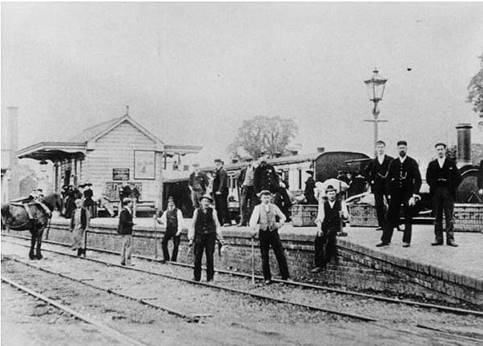
Anney, George Christopher worked for the Great Western
Railway for some 45 years and was stationmaster at Bourton on the Water
before becoming stationmaster at Moreton in 1904 until his retirement in
August 1921. He was very popular locally, and in October 1921 he was
presented with a gold watch, a cheque and an illuminated album by a committee
of local residents. He was a member of Stow Lodge of Freemasons and of
Moreton Bowling Club. His wife Susannah died on 22 January 1924 aged 59, and he died at 66
of pleurisy on 6 January
1926. They had no children.
Archer, Thomas. Born in Moreton in 1641, on 8 January 1669-70 he
married Sarah Huckin of Chastleton at Great Rollright. He was a blacksmith in
the High Street on part of what is now the Bell Inn (then called the George),
and owned both properties. He had seven children, the eldest of which -
Thomas, a gunsmith - pre-deceased him. He died on 27 April 1721. In his will of 6 October 1720
he left his working tools to his two surviving sons, Walter and Charles, who
became clockmakers in Stow, and his properties to his spinster daughter
Sarah, £20 to one son-in-law, Henry Weston, but only 1 s to the other, D
Beal, and £5 each to his grandsons by his dead son Thomas.
Aston, Edward Ernest. Police Sergeant Aston was
sergeant in charge at Moreton from 1918 until his retirement in June 1929
after 36 years service. He was the son of Mr 8s Mrs A Aston, of Leysbourne,
Campden, and was educated at the National
School, Campden. He
entered the police force on 1
September 1893, and served as a constable in Cheltenham,
Bishops Cleeve, Beckford, Cheltenham again,
Lechlade and Gloucester
before coming to Moreton. He married Miss Devereux of Kemerton, and they had
three daughters. On returning from his honeymoon he stopped two runaway
horses pulling an omnibus in Cheltenham. He
also did good work in a horse stealing case in Todenham in 1920. In Moreton
he was a member of the Four Shires Guild of Bell Ringers.
Baker, Reginald Langford (1836-1925). Born at Chepstow on 7
December 1836, Mr Baker came to Moreton in 1867 as manager of the
Gloucestershire Bank. He retired in 1908, by which time it had become the
Capital and Counties Bank (now Lloyds). He married Emma Marion Glutton Brock
of Pensax Court, Worcs. He was a member of the Rifle Volunteers, a
churchwarden, and chairman of the managers of the Council School.
He died at his home, Sunnyside, in the High Street on 4 March 1925.
Barking, Richard of. He
was prior of Westminster Abbey when he was elected its Abbot in 1222. He was
King Henry III's favourite adviser, and the King made him his special
counsellor and the chief baron of the Exchequer. He enlarged the Abbey's
estates, increasing its income by £200 a year. He spent most of his time at
his manor house at Eye and even when at Westminster,
mixed little with the monks, but in 1225 he settled a long-standing dispute
between monks and Abbot by dividing the Abbey's lands between them. In
1226-1228 he built the new town of Moreton Henmarsh on its present site along
the Fosse Way,
which he widened to make a long market place. The original hamlet then became
known as Old Town. He obtained several charters
from Henry III, in 1226 for a weekly market on Tuesdays, in 1228 one to make
this permanent, and in 1241 a third to hold the market on Saturdays instead
of Tuesdays. He died in 1246, assigning rents from his new town of Moreton to
celebrate his anniversary by the ringing of bells and chanting on the day following
St Matthew's Day, with wine and two good pittances for the monks and bread
and ale with broth and a dish of meat or fish for 100 paupers. He is buried
in the Lady Chapel of the Abbey.
Bloxam, Rev. Matthew.
Rector of Bourton on the Hill with Moreton in Marsh 17681784. He was an MA
of Pembroke College, Oxford,
and was ordained deacon by the Bishop of Worcester of 20 May 1733, and priest on 1 June 1735. In addition
to being Rector of Bourton, he was chaplain to the Earl of Coventry. In 1778
he was also presented to the more valuable rectory of Barwell, Leics., and
obtained a dispensation to hold both. In 1784 he resigned the Bourton living.
Brain, William. A Moreton farmer who died in the
spring of 1593, leaving his property to his son John. His daughter Ann got
one land each of wheat, rye, pulses and barley, the heifer he bought at
Compton, the bullock he bred the previous year, four strikes of wheat and
rye, his third best pot, his second best bed cover and pair of sheets, and
his second best cauldron. Her two daughters and John's son William got a
sheep each.
Busby, Henry Goodear (1798-1867). The third and last Busby to own the biggest business in Moreton in the
C19. He inherited from his father in 1821, and erected a linen factory in Church Street in
1824 on land he had been allotted in the 1821 inclosure which adjoined his
house (now the Manor House Hotel). In the 1830s and `40s he also had a
draper's business and managed the local branch of the Stourbridge &
Kidderminster Bank. He was a director of both the Stratford and Moreton Railway Company and
the Oxford, Worcester and
Wolverhampton Railway, and in 1845 presented each of his OWWR fellow
directors with a linen table-cloth made at his factory. In 1851 the factory
employed 100 hands, and he also farmed 200 acres on which he employed 18
labourers. He was a churchman, and was a churchwarden from 1851 to 1865,
presented the pulpit now in the church in 1858, and, with his fellow
churchwarden, paid for the recasting of the treble bell and two others when
they were rehung in the new tower in 1862. He also gave the town the land for
the Nonconformists cemetery. His wife died in 1864 and he followed her on 10 April 1867. They are
buried in the churchyard.
Nicholas Cartwright – The Rector of Bourton on the Hill with
Moreton in Marsh from 1617 to 1634. Born in 1584 to an ordinary
Worcestershire family, he matriculated at Balliol College,
Oxford, on 11 June 1602, got his BA
on 16 December 1605
and his MA on 25 June 1608.
On 15 July 1617
he was presented to the Bourton Hill living by the patron, Nicholas Overbury
Esq., and was sworn and instituted by the Chancellor. On the 15 November 1617 he
compounded for the first-fruits of his benefice, his sureties being Nicholas
Overbury again and another gentleman of Bourton on the Hill, John Gilbye. He
survived a series of episcopal visitations without comment - although he was
sometimes referred to as Timothy' Cartwright - and disappears from the
Bourton on the Hill record in 1634 when he was 50.
Gerald Clifton (1903-1990) – was born in Shenington near
Banbury, where his father George was a well-known stone mason. He established
a butcher's shop in Shenington and in 1932 bought Price's butcher's shop in
Moreton High Street. He was one of the leading butchers in the town and twice
president of the South Western Area Butchers Association and a former
chairman and director of Evesham Butchers. He joined the special constabulary
in 1938, rising to superintendent, and in 1967 was awarded the BEM. He also
had the War Service Medal and the Queen's Coronation Medal. He was a former
Town Councillor, Chairman of Governors of St David's School, and a Governor
of Campden Grammar School. He was twice married, his son Martin becoming a
doctor. He died on 28
December 1990, aged 87.
Samuel Creswick (1622-1683)
– the
youngest son of Francis Creswick of Bristol,
who had married Ann Nicholls of Moreton. He inherited his father's property
in Moreton, based on Lemington House, in 1649. He married Hester Ash of
Stowford, Wilts., and they had seven children: Hester, born 21 March 1661,
who married Richard Ingles of Stanton; Henry, 30 May 1662, who married Anne
Earle of Bradenbrook, Wilts.; Samuel, 8 November 1663; Ann, who died
unmarried in 1757; Elizabeth, who married Penyston Hastings of Daylesford;
John, 30 December 1669, buried 20 February 1670; and Jonathan, 21 December
1670, buried 14 January 1672. Mrs Hester Creswick died in 1682, and Samuel
himself on 24 April 1683
at the age of 61. His will, made two days before he died, asked that he be
buried as near as possible to his wife in the chancel of St David's, and left
40s to Moreton's poor and £10 to St David's, £200 to Elizabeth Hastings on
condition her husband let Henry Creswick off the marriage bond, £800 to
Richard Ingles as his daughter Hester's marriage portion, four full length
pictures to Elizabeth Hastings, and to Hester Ingles a silver tankard, six
silver spoons, and the red bed with its furniture and a quilt. Minor bequests
to servants and others included £50 to Hester Harper, 10s to Mathew Norton,
40s to Mrs Ivor, 10s to John Owyn, and 20s for rings to his brothers John and
Joseph Creswick. The flat memorial stone in St David's bore his coat of arms,
a red lion rampant reguardant on a gold background.
John Crocker esquire – the owner of the first Batsford Park in the late C16 and early C17,
and the third and last of his family to possess the manor. He was the son of
the previous John Croker who had married Elizabeth Freeman of Batsford. He
married Joan Riddall of Riddall in Herefordshire, by whom he had a number of
children, not all of whom lived beyond infancy. His eldest surviving
daughter, Dorothy, baptised at Batsford on 30 April 1592, married John Hales of Coventry, while her
sister Mary married Sir Robert Pye and the youngest, Joan, Edward Goddard of Southampton. On 18 November 1619 John Crocker made a family
settlement dividing his estate between his three daughters. But when he died
on 6 April 1630,
only Lady Mary Pye had survived him.
Mrs G M Dee (1895-1979)
– one of
the most popular residents in Moreton for nearly 50 years. She grew up at
Frampton Farm, Alderton, and was a Miss Slatter before her marriage to James
Carpenter Dee. They farmed at Shenberrow Farm, Stanton, and Hailstone Farm,
Blockley, before settling in Moreton. During the Great War she did VAD
nursing at Dumbleton Hall. During WWII and afterwards she worked in the box
office of the Playhouse Cinema, and provided a home-from-home at The Cottage,
Oxford Street, for airmen stationed at RAF Moreton and for many newcomers to
Moreton. She was a WI member and a keen bridge player, but was most widely
known as a bowls player, both at Moreton and Broadway, but also for
Worcestershire; she also took part in the national bowls championships at Wimbledon on several occasions. She and her husband,
who predeceased her, had two sons and four daughters, all of whom survived
her when she died at 84 in January 1979.
Robert Drury (1848-1924)
– was the
second son of William John Drury of Moreton. In the early 1870s he set up a
stationery shop at the old Post Office, north of the Redesdale Arms, which he
later rebuilt and modernised. He married Emma Peach of the town, in whose
memory he presented the oak screen in St David's. He was in the church choir
and a trustee of the local lodge of Oddfellows.
1st Lord Dulverton (1880-1956).
He was the second but eldest surviving son of Sir Frederick Wills, the lst
baronet, of North Moor, Somerset.
He was an MA of Oxford University, and in 1914 married Victoria May, daughter of Rear-Admiral Sir
Edward Chichester. He served as a Captain and Major in the Great War, first
with the Royal North Devon Hussars and then with the Machine Gun Corps in
Gallipoli and France. He was mentioned in dispatches and awarded a military
OBE. Before he came to Batsford he was Master of the Dulverton Hounds. He was
also a sculptor who had exhibited at the Royal Academy,
a musician and a writer of verse. He sat in the Commons as Conservative MP
for Taunton
1912-1918 and as Coalition MP for Weston-super-Mare
1918-1922. In 1921 he was PPS to the Postmaster-General. He was President of
the Moreton Cottage Hospital 1919-48, bought the Redesdale Hall for the town,
and presented the town's football field. He was awarded the TD and made a JP.
In 1928 he was High Sheriff of Gloucestershire. He was Chairman of the
Imperial Tobacco Company 1924-1947 and then President until his death. He was
also a director of the GWR. He was raised to the peerage as Lord Dulverton of
Batsford in 1929. He was always a great benefactor to charitable causes,
including Guy's Hospital in London,
and the restoration of St Mary Redcliffe, Bristol, and in 1949 set up the Dulverton
Charitable Trust, designed especially to aid youth and conservation. In 1951
he presented the Redesdale Hall to the local authority. He died in 1956,
leaving his widow and three sons, the eldest of whom, Frederick Anthony
Hamilton Wills, born 1915, succeeded to the peerage.
George James Dyer (1894-1915)
– one of
the 44 men of Moreton and Batsford who fell in the 1914-1918 war, was the
fourth son of William and Emma Dyer of New Road, Moreton. His father had been
groom-gardener for Dr Yelf's family for 44 years when he died in January
1925. All six of William Dyer's sons fought in the Great War. George Dyer was
a regular soldier with the 2nd Worcesters
in 1914, and landed in France
on 12 August 1914.
He went through the battle of Mons,
but was wounded in October. In May 1915 the 2nd Worcesters mounted two unsuccessful attacks
along the Richebourge Front against enemy positions that had not been broken
by artillery fire. In the second attack on 14 May the 2nd Worcesters lost 250 men. George Dyer was
first reported as missing, but in November 1915 it was confirmed that he had
been killed in the battle of Festubert on Sunday, 16 May 1915. He was only 20 years of
age. He is commemorated on Moreton's War Memorial and on the Le Touret
Memorial, Pas de Calais, France.
Herbert Hinton d'Este East (27.5.1851-20.5.1919) of
Bourton House died of heart failure in May 1919 aged 67. He had come to
Bourton House nearly forty years before on the death of his wife's uncle, Sir
James Buller East, but they had then lived for some years in the south of France
for his wife's health before returning in 1907. For nine years until March
1918 he represented Moreton on the Gloucestershire County Council, and was a
prominent member of the Board of Guardians and Rural District Council. For ten
years he had been chairman of Bourton on the Hill Parish Council and of the
local War Savings Committee, which he had been instrumental in setting up. He
was also a member of the Campden War Pensions and Old Age Pensions Committee.
He was one of the longest supporters of the Moreton in Marsh Cricket Club and
President of the Moreton Bowling Club, and one of the trustees of the Moreton
Cottage Hospital. He was one of the managers of the Church Schools and a
governor of Studley
Agricultural College.
He had travelled widely, and had long been convinced of the reality of the
German menace, and gave lantern lectures in the neighbouring villages on the
necessity of National Service for all. He had always been very fond of
children, and large numbers of them attended his funeral in Bourton Hill
church.
John Edgley (bu. 29.7.1661), a Moreton
butcher in the mid-C17, married his wife Ann in the 1630s, and had two sons
and six daughters, though two daughters died in infancy. He lived and worked
in a house in the High Street which enabled him to graze cattle on Moreton
Heath. He was a very pious man, and a great friend of the most prominent
Moreton citizen of that time, Samuel Creswick of Lemington House. When he
made his will a few weeks before his death in July 1661 he described Samuel
Creswick as `his loving friend'. He left his house to his wife Ann and then
to his eldest son John. The second son then got £20 and each of the four
surviving daughters £5. His will, to which he made his mark, was proved on 14 October 1661.
Albert W Edmunds (1848-1933) came to Moreton in
1913 as licensee of the Swan Inn, which he kept for several years, and then
took over the management of the Crown Inn until it closed in 1921, when it
was converted into the Curfew Garage. He retired to Bournheath near Bromsgrove,
where he died just short of his diamond wedding, leaving a widow, a son and
four daughters.
George Eldridge (1882-1923) was married and had
a wife, Mabel Alice, and worked for the GWR in their carriage works at
Oldbury before the Great War. He joined up in the first month of the war,
being drafted as a Private to the 1 st Battalion of the Rifle
Brigade. He arrived in France
on 26 January 1915,
and at the Battle of Neuve Chapelle he received severe wounds in the back and
leg. After a year in hospital he was discharged from the Army in March 1916
as being no longer fit for war service. He received the 1914-15 Star, the
British War Medal and the Victory Medal. He then worked as a motor mechanic,
but developed tuberculosis, and died at his home in East Street on 30 November 1923, aged 41.
George H Ellis (1855-1928) was the eldest son
of George Ellis, a carpenter and upholsterer of Moreton, and lived and died
in the same house in Moreton from the age of 10. In 1908 he married Miss
English of Oxford,
and until 1925 carried on the same trades as his father. He took an active
part in the formation of the local Sick and Dividend Society, and for
twenty-one years was its hon. treasurer and secretary. He was also a member
of the British Legion.
Back to the top …
|